

To find customers for your small business in the USA in 2026, start with a specific customer, a clear offer, and two channels you can manage consistently. Make your business easy to discover, show evidence that you can deliver, and give interested people a simple way to take the next step. Then track which inquiries become paying customers.
That approach works whether you run a cleaning company, offer bookkeeping, teach private lessons, repair homes, or operate a neighborhood studio. The details vary by business, but the goal stays the same: build a repeatable path from discovery to a profitable customer relationship.
This guide explains where to find small business clients, how to convert local interest into bookings, and what to do during your first 30 days. The numerical examples are planning illustrations, not industry benchmarks or promised results.
- 1. Choose the customer you can serve best
- 2. Turn your service into an offer people understand
- 3. Help nearby customers discover your business
- 4. Use a relevant service marketplace as a discovery channel
- 5. Build service pages that answer buying questions
- 6. Use social content to demonstrate your work
- 7. Build referral relationships with complementary businesses
- 8. Follow up with a useful next step
- 9. Test paid advertising after the basics work
- 10. Measure the path from inquiry to customer
- Your first 30 days: a practical customer acquisition plan
- Week 1: Build the foundation
- Week 2: Get discovered
- Week 3: Start conversations
- Week 4: Improve what works
- Common mistakes that make it harder to get clients
- Frequently asked questions
- How do I find my first customers with a small budget?
- What is the best way to get local customers in the USA?
- Do I need a website to get clients?
- How long does it take to get customers?
- Should I use AI to market my small business?
- Start with one clear path to a new customer
1. Choose the customer you can serve best
“Everyone in my city” is too broad to guide a marketing decision. A useful customer definition includes a location, a specific need, and a reason to act now.
A house cleaner might focus on busy households in three nearby ZIP codes. A bookkeeper could serve independent contractors who need organized monthly accounts. A photographer might specialize in headshots for professionals changing jobs.
Write one sentence: “I help [specific customer] in [area] solve [specific problem] with [service].” Use it to decide which communities, search queries, and partners deserve your attention.
Before committing, talk to a few potential customers. Ask what they currently do, what frustrates them, and what makes them trust a provider. Avoid turning the conversation into a pitch. You are looking for the language people use before they buy.
2. Turn your service into an offer people understand
Customers should not have to decode a vague description such as “quality solutions for all your needs.” Explain the job, the area you cover, what is included, and how to request an estimate.
For example: “Move-out cleaning for apartments in North Austin. Kitchen, bathroom, floors, and interior surfaces included. Send your apartment size and preferred date for a written quote.”
A strong offer answers five questions:
- Who is this service for?
- What problem will you handle?
- What is included, and what costs extra?
- Where and when can you provide it?
- What should the customer do next?
Use starting prices only when you can explain their conditions. If every job needs an assessment, say what information you need to prepare a quote. Clear expectations help prevent inquiries that were never a good fit.
3. Help nearby customers discover your business
For an eligible local business, a complete Google Business Profile is a practical starting point. Google’s local-ranking guidance identifies relevance, distance, and prominence as central factors. Accurate information helps customers understand whether your business matches their needs; paying someone cannot buy a better organic local ranking.
Check your business category, contact details, opening hours, service area, and photos. Follow Google’s eligibility and address rules, particularly if you travel to customers instead of receiving visitors at a storefront. Keep your details consistent wherever you publish them.
After completing a real job, invite the customer to leave an honest review. Do not offer rewards for positive reviews or ask only happy customers. Reply thoughtfully and avoid sharing private information about the job.
Make this a weekly habit: check for inaccurate hours, unanswered inquiries, and new reviews. A polished profile is useful only if the business behind it is responsive.
4. Use a relevant service marketplace as a discovery channel
A marketplace can give potential customers another place to find and compare your services. Choose one that fits your category and location, and treat your listing as a focused service page.
For local service providers, JustList is an option to explore. Its website lets visitors browse service categories and locations, while providers can prepare service profiles and review publication options. Check the current terms, available options, and activity in your area before committing time or money.
Describe one clear service, upload original work photos, state your coverage area, and explain the next step. Track inquiries from the listing separately so you can judge whether it brings relevant conversations.
Disclosure: JustList is a project we promote. A listing does not guarantee leads, bookings, or revenue.
for free
5. Build service pages that answer buying questions
Your website does not need dozens of articles to help a customer make a decision. Start with a useful page for each core service. Include the area you genuinely cover, the job scope, your process, relevant examples, pricing context, and one clear contact action.
For a lawn care company, that could mean a page explaining recurring mowing, what happens to clippings, how gates and pets are handled, and when extra work needs a separate quote. Those details are more useful than repeating “best lawn care near me.”
In 2026, AI-assisted search adds another reason to publish clear, trustworthy information. Google’s guidance says foundational SEO still matters for generative AI search features. Focus on useful original content and an accessible website rather than promises of guaranteed AI recommendations.
Show genuine project examples with permission. Explain an actual problem, your approach, and the outcome you can substantiate. Keep important information in readable page text rather than hiding it entirely inside images.
6. Use social content to demonstrate your work
Pick a platform your customers actually use. A visual service may suit short videos and before-and-after posts. A professional B2B service may benefit more from thoughtful posts and conversations on LinkedIn. A neighborhood business may find useful discussions in local groups.
Create content around questions you hear during estimates:
- What changes the price of this job?
- What should a customer prepare before you arrive?
- Which problems can be handled during a standard visit?
- When is a specialist needed?
- What does a completed project look like?
For each post, choose one purpose: answer a question, show a real example, or explain the next step. Get permission before showing a customer’s face, home, address, or identifying details.
In community groups, follow the posting rules and contribute relevant answers. Repeating the same advertisement across every discussion can damage the trust you are trying to build.

7. Build referral relationships with complementary businesses
Look for businesses that serve similar customers at a different stage of the job. A move-out cleaner could connect with property managers. A photographer could meet website designers. A bookkeeper could build relationships with independent business consultants.
Start with a small, specific introduction. Explain who you help, the work you handle, and how you would respond to a referral. Ask which customer problems the other business struggles to solve.
Try this message:
“Hi [Name], I run [business] and help [customer type] with [service] in [area]. I noticed your team works with a similar audience. If clients ever ask about [specific problem], I would be happy to explain our process. Would a brief introduction be useful?”
After a successful job, make referrals easy for customers too: give them a short description they can share. Never assume permission to contact someone whose details a customer casually mentions; ask for an introduction.
8. Follow up with a useful next step
A lead can stall because the customer is busy, the estimate is unclear, or the next action feels difficult. Decide who handles inquiries and set a response window you can reliably meet.
First, confirm the request. Ask only for the details needed to assess the job, such as location, scope, timing, and relevant photos. Then send a quote with inclusions, exclusions, and a clear way to accept or ask questions.
A helpful follow-up sounds like this:
“Hi [Name], checking whether you had any questions about the estimate for [job]. If the scope or timing has changed, I can revise it. Would you like to discuss the available dates?”
Keep follow-ups proportionate and stop when someone declines. Use marketing messages only through channels where you have the appropriate permission. A simple lead tracker should record the source, request, next action, and outcome without collecting unnecessary personal information.
9. Test paid advertising after the basics work
Paid ads can accelerate discovery, but they also expose weaknesses in your offer and follow-up process. Before launching, test your contact form, phone routing, mobile page, and quote workflow.
Start with one service, a realistic geographic area, and a fixed test budget you can afford. For search campaigns, focus on queries that describe a service someone could actually hire you for. Review irrelevant queries and whether the leads are inside your coverage area.
For social campaigns, show a specific problem and a credible service example. Do not promise outcomes you cannot support or advertise availability you do not have.
Judge the test by qualified inquiries and paying customers. Cheap clicks are not useful when they come from people who cannot buy your service. Set a review date and a spending limit before the campaign starts.
10. Measure the path from inquiry to customer
A small business does not need a complicated dashboard to improve customer acquisition. Review a short list of numbers for each channel every week.
| Metric | What to record | What it helps you decide |
|---|---|---|
| Inquiries | New calls, messages, or form submissions | Is the channel creating conversations? |
| Qualified leads | Requests matching your service, area, and capacity | Are you reaching suitable customers? |
| Quotes sent | Written offers delivered to suitable prospects | Where do conversations stop progressing? |
| New customers | People who made their first purchase | Is the channel producing business? |
| Acquisition cost | Defined acquisition spending divided by new customers | Does the cost fit your margins? |
| Repeat business | Customers who return within a defined period | Are you building a durable relationship? |
Illustrative calculation: if a campaign costs $300 and produces five new customers, its advertising cost per new customer is $60. If you also spend $100 on campaign setup, the combined cost is $80 per customer. State which costs you include and avoid counting the same customer twice across channels.
Compare that cost with the contribution left after delivering the service, not just the invoice total. Do not assume every new customer will return. Use actual repeat purchases as your records grow.
Your first 30 days: a practical customer acquisition plan
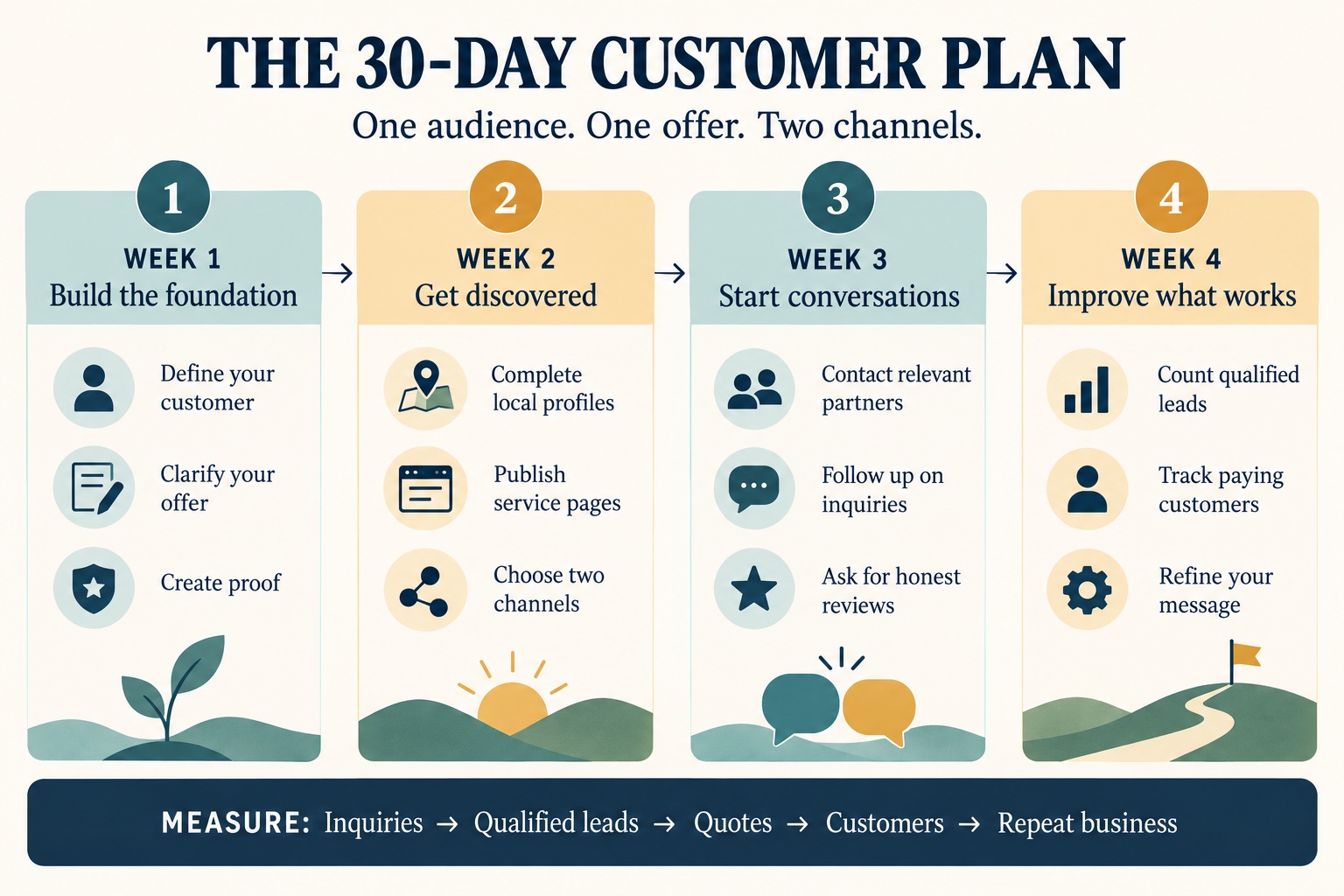
Week 1: Build the foundation
Choose one customer group and one main offer. Gather genuine work examples or clearly labeled samples. Make sure a prospective customer can understand your service and contact you from a phone. Create a simple lead tracker.
Week 2: Get discovered
Complete the local profiles you are eligible to use, prepare a focused marketplace listing, and improve your main service page. Choose two channels for your first test. Keep the workload small enough to maintain.
Week 3: Start conversations
Introduce yourself to relevant partners, publish useful service content, and follow up on open inquiries. After completed jobs, request honest feedback. Record the questions people ask before they agree to buy.
Week 4: Improve what works
Count qualified leads, quotes, customers, and acquisition spending. Fix the biggest bottleneck: weak targeting, unclear scope, missed calls, or slow estimates. Continue the channel that produces useful conversations and revise the weaker one before increasing spending.
Common mistakes that make it harder to get clients
- Opening too many channels at once. An abandoned profile and unanswered inbox can undermine a good offer.
- Competing only on price. Explain scope, reliability, and relevant experience so customers can compare more than a number.
- Using generic or misleading proof. Label stock or AI illustrations, and use real work to substantiate your claims.
- Measuring attention instead of business. Followers and impressions do not tell you which customers paid.
- Ignoring existing customers. A useful reminder about a relevant recurring service may create more value than chasing another audience.
Frequently asked questions
How do I find my first customers with a small budget?
Start with a focused offer, genuine examples, warm introductions, and relevant local communities. Complete the profiles available to your business and ask people you already know for appropriate introductions. Free channels still require time, consistency, and responsive service.
What is the best way to get local customers in the USA?
A useful starting combination is local discovery, clear service information, and referrals. Your best channel depends on what you sell, your location, the urgency of the need, and where customers already look. Test the combination against actual qualified inquiries.
Do I need a website to get clients?
You can start through referrals and relevant profiles. A simple website gives you more control over how you explain your service, show evidence, and accept inquiries. It becomes especially useful when customers need to compare scope or understand a complex offer.
How long does it take to get customers?
There is no reliable universal timeline. Warm introductions may create conversations quickly, while search visibility and referral relationships can take longer to develop. Use the first month to test your process and establish a baseline.
Should I use AI to market my small business?
AI can help organize ideas, draft service descriptions, and prepare follow-up templates. Check every claim and keep your own judgment in the process. Never invent customer reviews, credentials, project results, or photos presented as completed work.
Start with one clear path to a new customer
Choose the people you can help, explain the job clearly, and make it easy to contact you. Combine two manageable discovery channels with reliable follow-up. Each week, use the results to improve your message and your process. That is a practical way to find customers for your small business in 2026 without turning marketing into an endless list of disconnected tasks.
Editorial research: Google Business Profile Help, “Tips to improve your local ranking on Google”; Google Search Central, “Optimizing your website for generative AI features on Google Search”; JustList public website. Reviewed October 11, 2026. Photorealistic scenes are AI-generated illustrations, not customer testimonials or documented projects.