Pensamiento

Тренировать pensamiento con ejercicios breves basados ​​en la ciencia diseñados para ayudarle a desarrollar hábitos cognitivos más sólidos mediante la práctica regular.

  • Práctica personalizada
  • Progreso que puedes seguir

Explora las habilidades cognitivas

Elija un área cognitiva y descubra habilidades, ejercicios y materiales de aprendizaje relacionados.

guía de habilidades

Acerca de pensamiento

Different Facets and Primary Functions of Human Thinking

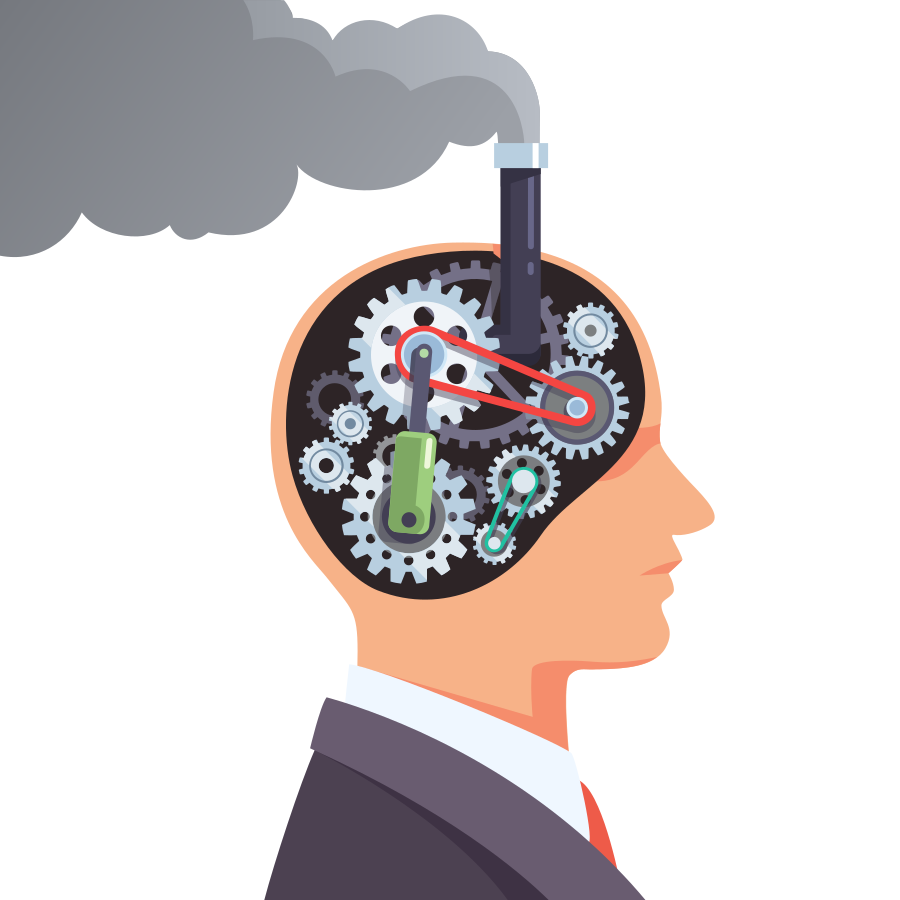
Thinking is the greatest manifestation of human intellect. It is a complex and multifaceted process that enables individuals to perceive, analyze, and interpret information from the world around them. Thinking allows people not only to efficiently solve everyday tasks and problems but also enables scientific exploration, artistic creativity, and even philosophical contemplation on profound life questions and existence.

Key Functions of Thinking

  • Analysis – entails a detailed examination of information by breaking it down into its constituent elements. For instance, when studying a new gadget, analysis helps understand the functions performed by each button.
  • Synthesis – involves combining disparate data into a unified structure or theory. This can be observed in scientific work where isolated facts are interconnected into a common hypothesis.
  • Generalization – is the identification of common patterns from a variety of specific facts, necessary for establishing principles or rules. For example, studying market behavior allows generalizing that prices rise before major holidays.
  • Abstraction – focuses on the key elements, disregarding irrelevant details, which is crucial in mathematics and programming.
  • Classification – sorting objects and phenomena into categories based on shared properties, as seen in biology when classifying living organisms.

Thinking functions, such as analysis and synthesis, play a pivotal role in scientific and technical research as they facilitate the development of innovative technologies and resolution of intricate engineering challenges. Generalization and abstraction are integral to learning and adaptation, allowing the application of accumulated knowledge to solve new, unforeseen problems. Thinking in its diverse forms acts as a bridge connecting practical tasks with theoretical inquiries and supports not just academic progress but also personal growth.

Various Types of Thinking and Their Significance in the Modern World

Thinking is a complex and multifaceted process that influences all aspects of our lives. The effectiveness of problem-solving largely depends on the type of thinking we apply. Each type of thinking has its unique characteristics and areas of application, and understanding these differences can help us work better and develop.

Concrete and Abstract Thinking: From Tangible to Ideal

Concrete thinking is focused on direct perception and representation of real objects and their properties. For example, when we look at a bridge, concrete thinking helps us assess its materials, structure, and purpose. Abstract thinking, on the other hand, allows us to rise above the details and see general patterns or theoretical concepts. This type of thinking is crucial for developing scientific theories or philosophical concepts, such as formulating laws of physics that apply not only to one bridge but to all bridges in general.

Logical and Creative Thinking: Between Rigor and Freedom

Logical thinking involves analyzing information using strict rules and sequences. It is based on data, evidence, and clear reasoning. This approach is extremely important in fields where precision and reliability are required, such as in mathematics or programming. On the other hand, creative thinking is focused on creating something new, transforming the existing, and seeking unconventional solutions. It finds its application in art, design, or advertising, where success often depends on the uniqueness and novelty of an idea. A great example of a creative approach is an advertising campaign that goes beyond the ordinary and thus attracts a larger audience's attention.

"Thinking is not only knowing one correct path, but also the ability to see multiple different paths leading to the goal and choosing the most suitable one." - Karl Popper, a prominent philosopher.

Successful individuals often skillfully combine different types of thinking depending on the situation, allowing them to be flexible and adapt to changing conditions. This versatile thinking becomes especially valuable in an era of rapid technological and social changes.

Application of Critical Thinking in Everyday Life

In our daily lives, we rarely stop to think about the complex cognitive processes happening in our brains. These processes impact all aspects of our activities, from simple grocery shopping decisions to strategic planning for a family vacation. These daily actions require us to analyze, synthesize, abstract, and generalize information.

Our cognitive abilities give us a unique approach to solving any task. For example, when choosing a product at the store, one person may consider the nutritional value and health benefits, while another pays attention to price and brand. When planning a vacation, someone may focus on cultural enrichment, exploring historical sites, while another prefers relaxing on the beach with a focus on leisure and entertainment.

Developing critical thinking skills leads to increased overall cognitive flexibility, allowing us to better adapt to changes, be more effective in learning and professional activities, and contribute to personal growth and self-realization. For instance, students with well-developed analytical skills can more effectively absorb complex educational material, while leaders with strategic thinking skills can develop successful long-term company growth plans.

Therefore, critical thinking processes play a crucial role not only in academic and technical fields but also in countless aspects of our daily lives. They not only help us better adapt to a constantly changing world but also engage our creative potential, promote self-expression, and stimulate our personal growth.

Juegos que entrenan pensamiento

Elige un ejercicio y empieza a practicar esta habilidad cognitiva en un formato interactivo sencillo.

Todos los juegos

curso para desarrollar pensamiento

Curso de desarrollo del pensamiento

Expande los límites de tu pensamiento con nuestro curso, que te enseñará el pensamiento creativo y la resolución de problemas complejos. El curso refrescará tu pensamiento y proporcionará nuevas perspectivas sobre el pensamiento crítico, la memoria, la imaginación y la atención.

  • Tareas prácticas
  • Teoría interesante
  • 10 juegos
Activar curso Todos los cursos

Artículos sobre pensamiento

Obtenga más información sobre habilidades cognitivas, métodos de entrenamiento y formas prácticas de mejorar sus habilidades.

Todos los artículos

Entrena tu cerebro en cualquier lugar

Comience en el sitio web y luego continúe con sus entrenamientos cognitivos en cualquier momento en la aplicación móvil BrainApps.

También disponible en móvil
Pantalla de la aplicación BrainApps
Pantallas de la aplicación BrainApps
BrainApps utiliza cookies para ofrecer la mejor experiencia en nuestro sitio web. Por favor, revise nuestra Política de cookies para más información.