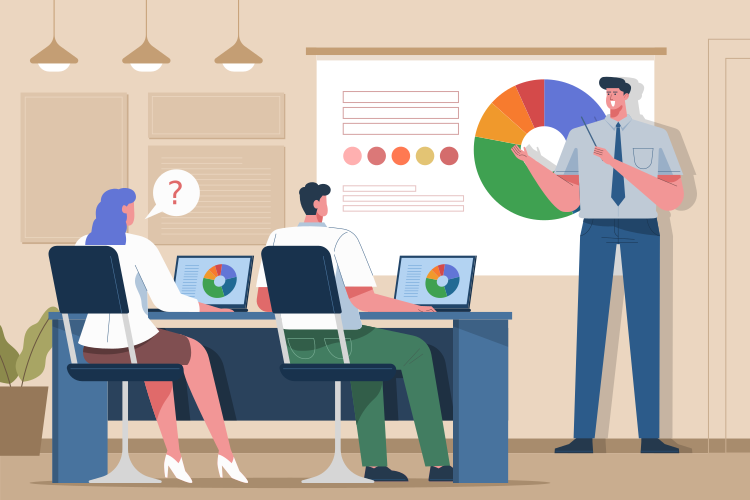

- How a stalled product launch became a teamwork rescue
- What teamwork actually means (and when to choose it)
- Why teamwork matters – real business benefits, not just feel-good perks
- The CORE framework – a one-page playbook for effective teamwork
- Common goal
- Ownership & roles
- Respectful communication
- Execution routines & feedback
- Practical day-to-day moves that actually promote teamwork
- Team-building exercises that build skills (not just icebreakers)
- Common teamwork mistakes and how to fix them, fast
- Conclusion & quick FAQ – essential answers about teamwork
How a stalled product launch became a teamwork rescue
Three weeks before launch the product tanked: a last-minute feature conflict, a misread legal clause, and an unexpected performance bug. Individually, engineers, designers, and the PM could only react. Together, they triaged, reworked, and shipped on time.
Diagnosis in one line: teams fall apart when purpose, roles, communication, or routines are missing. That pattern shows up whether you call it teamwork, collaboration, or cross-functional coordination.
Preview: use CORE – a one-page playbook that answers “what is teamwork” with a practical framework you can apply immediately.
What teamwork actually means (and when to choose it)
What is teamwork? It’s people intentionally working interdependently toward a shared, measurable goal. The difference from cooperation or parallel work is interdependence: the outcome depends on coordinated contributions, timing, or tradeoffs.
When to choose teamwork vs solo work:
- Pick teamwork for complexity, uncertainty, creativity, or scale – when one person can’t deliver the result end-to-end.
- Choose solo work for short, well-scoped tasks, deep focus, or clear individual ownership.
Concrete examples that clarify the teamwork definition:
- Moving a couch – quick coordination; two people can handle it with a plan.
- Designing a poster – divided craft plus shared reviews; mostly parallel work with checkpoints.
- Shipping a product launch – true interdependence: timing, tradeoffs, and go/no-go decisions require everyone in sync.
Why teamwork matters – real business benefits, not just feel-good perks
The benefits of teamwork are tangible and measurable. Good teamwork helps you:
- Achieve bigger goals that no single person could deliver.
- Solve problems faster through parallel investigation and cross-checks.
- Make better decisions by surfacing diverse perspectives and avoiding blind spots.
- Build resilience so teams recover faster after setbacks and retain knowledge.
Illustration: a cross-functional sync uncovered an API rate-limit two days before launch and avoided a costly rollback – a small routine change prevented major downtime.
Employee experience follows: effective teamwork builds belonging and meaning, which improves retention and performance.
The CORE framework – a one-page playbook for effective teamwork
CORE = Common goal, Ownership & roles, Respectful communication, Execution routines & feedback. Use it in order: set a clear goal, assign who decides and does, agree how you talk, and lock in routines to keep progress visible.
Common goal
Write a single-sentence shared goal everyone can repeat. Template: “We will X by Y to deliver Z for W.” Keep it measurable and time-bound. If someone can’t summarize the work in that sentence, alignment isn’t there yet.
for free
Example: “We will generate 2,000 qualified leads by June 30 to deliver Q3 pipeline for the SMB product.” Pin it where the team sees it.
Ownership & roles
Distinguish task ownership from decision rights. Use a RACI-lite model: Responsible (does the work), Accountable (makes the call), Consulted, Informed. Practical rule: one clear owner per decision – ambiguity stalls progress.
Example (poster): Responsible – Designer, Copywriter, Media Buyer; Accountable – Marketing Lead; Consulted – Legal, Sales; Informed – stakeholders via weekly digest.
Respectful communication
Agree rules of engagement: short standups, a single decision owner, and a structured disagreement protocol. Make debates about ideas, not people.
“I see X, my concern is Y because Z, one suggestion is A.”
Start meetings with the one-sentence goal, list required decisions, and end with actions + owners.
Execution routines & feedback
Rituals keep momentum. Pick simple cycles: 15-minute daily syncs, weekly demos, monthly retros. Track one core metric the team cares about and use a tight feedback loop: observe → impact → request.
Feedback template: observe → impact → request. Example: “I noticed the feature shipped without tests (observe). That caused two rollbacks (impact). Can you add the automated test before the next deploy? (request)”
Practical day-to-day moves that actually promote teamwork
Do these in the next seven days – each takes under an hour and creates visible improvement fast.
- Set and pin the one-sentence team goal.
- Run a 30-minute role-clarity session using RACI-lite to assign decision owners.
- Start a 15-minute demo cadence: show progress, surface blockers, capture actions.
Tools and rituals that matter, not every tool: a single source of truth (board or doc), short asynchronous updates (status / blocker / ask), and a simple decision log (what / who / date).
Scripts and micro-behaviors that change dynamics:
- Invite quieter members: “Alex, what’s one risk you see in 30 seconds?”
- Acknowledge mistakes publicly: “I missed the spec – my action is X.”
- Two-line recognition: “Thanks [name] – your work on X cut our time by Y.” (Keep it specific.)
How to measure progress: watch two KPIs – decision cycle time (issue → decision) and cross-functional handoffs completed without rework. Review weekly and pick one small change per retro.
Team-building exercises that build skills (not just icebreakers)
Choose exercises tied to a skill outcome – psychological safety, coordination, or accountability – and always debrief. Practice + reflection beats entertainment.
- Two Truths & A Lie – psychological safety: Lowers social risk and humanizes teammates. Keep it voluntary, work-appropriate, and timeboxed (60 seconds per person). Remote option: use chat reactions then a volunteer explains.
- Picture Piece Puzzle – coordination & emergent Leadership: Each person has an unseen slice and must assemble together. Remote variant: distribute image fragments and require verbal assembly. Debrief who led and how roles formed.
- Mini shared sprint (2-day) – shared accountability: Day 0: set a one-sentence goal and success metric. Day 1: prototype and demo. Day 2: iterate, finalize, retro with two improvements. Outcome: a small deliverable and tested workflow.
Common teamwork mistakes and how to fix them, fast
Pair each frequent mistake with a short corrective script or micro-template you can use immediately.
- Assuming alignment is fixed – Fix: require a one-sentence goal and verbal readback. Script: “Repeat the goal and state your key risk.”
- Over- or under-coordination – Fix: choose a cadence and name one owner per decision. Script: “Decision X owned by Y; reconvene Friday.”
- Blaming individuals for failures – Fix: run a blameless postmortem focused on process. Opener: “What allowed this to happen?”
- Quiet voices getting ignored – Fix: round-robin speaking, anonymous idea capture, or small-group priming. Script: “Each person gets 30 seconds.”
- No feedback loop – Fix: implement a 10-minute retro and pick one metric to change next sprint. Retro: What went well / What didn’t / One change.
Conclusion & quick FAQ – essential answers about teamwork
Teamwork is coordinated interdependence: a clear goal, defined roles, agreed communication, and steady routines. Start with CORE, run the seven-day moves, and use short scripts to fix common teamwork mistakes. Do that, and your next big task becomes one the team owns – and wins.
What is teamwork in one sentence? A group intentionally working interdependently toward a shared, measurable goal – not just parallel tasks.
How do I know if my team needs more or less teamwork? Add teamwork if you see frequent rework, missed handoffs, slow decisions, or last-minute rescues. Reduce meetings if approvals duplicate work or micromanagement is constant. Track decision cycle time and handoffs without rework to decide.
How long to build effective teamwork? Visible improvement in 1-2 weeks with a one-sentence goal, clarified roles, and a demo/standup cadence. Reliable routines and behavior change usually take 2-3 months; deeper trust and culture take sustained practice.
How do remote teams keep real teamwork alive? Use one source of truth, two-line async updates (status / blocker / ask), RACI-lite checks, a short live cadence, remote-friendly exercises, and rules for structured disagreement and round-robin input.